Tuesday, September 11, 2012

Top 10 Reasons Parents Give for Not taking their Children to Counseling


I hear many reasons from parents about why they had such a hard time coming to counseling or approaching a therapist.  As a parent myself, I understand these and have often felt them.  However, also, as a parent, I have to put aside my own fears and stigmas and do what is best for my child. 

Here are the top 10 reasons I hear for not going to counseling:

10. Only really emotionally disturbed people go to counseling
     Truth - Counseling is for everyone, even counselors.  The purpose of a counselor is to help their client achieve their goals.  All of us have goals and when we have an advocate to partner with us on those goals, we can achieve them quicker and easier.

9. Counseling is too expensive
     Truth - Yes, some counseling is expensive, but not all counseling has to be.  Some insurance plans cover mental health, but if yours does not, you still have options.  You can ask different counselors for their rates.  Many counselors work off a sliding scale that is based on income.  As an intern therapist (which are Master's level students working on their licensure), I often saw clients for $10 an hour.   


8. I can't take off work every week to take my child to counseling
     Truth - As a family therapist, I strongly value the family being present for sessions.  Many family therapists and child therapists feel this way also.  I work evening hours just for this reason.  I also travel to pre-schools or other schools to see the child there so the parent does not have to leave work and bring the child to my office.  Many counseling agencies also provide these services. 

7. I don't want my child to think there is something wrong with them
     Truth - I'm going to be honest with this one.  Most kids already know that something is not right, or that something different is going on.  The relief that I witness in a child when they know their parent has validated these feelings and made the child's wellness a priority is amazing.  Often times, this is the beginning of healing for many children.  When we as parents deny that something is going on, we hinder our child from growing and continue to allow the issues to occur.

6. I can fix it myself
     Truth - Yes, there are a lot of things that a parent can do to help their child.  But, there are also things that 1) you might not know how to do and 2) your child is going to hear and respond better to someone that is not their parent...especially teenagers. 

5. It really isn't that bad, plenty of kids act worse
     Truth - There are all levels of severity that I see in my office.  I even see children for preventative work.  A child (or adult) does not have to be at a certain level of "badness" to go to counseling.  If there are things that are negatively influencing the child or family, a counselor can help.

4. He/She is too young to go
     Truth - As a play therapist, I have training in infant and toddler counseling.  I also work with foster families and adopted children.  Research has shown that the earlier an issue is presented and worked on in counseling, the better long term results that occur.  The longer a child has to develop bad habits, low self-esteem, negative coping skills, etc. the harder they are to correct.

 
3. I don't want my child to have a diagnosis or label that will follow them around
     Truth - If you use your insurance to pay for counseling your child will most likely have to be given a diagnosis so that insurance will see the counseling as medically necessary.  However, if you look around you will be able to find counselors that do not bill through insurance and do not have to give a diagnosis to a young child. 

2. I don't know who to go to
    Truth - Unfortunately, this one does not have an easy answer.  It takes some digging and time to find the best counselor for your child.  There are many different types of counselors, all with unique personalities.  This allows for all children to be able to have a counselor out there that fits with their personality and needs.  You can look online for a list of Registered Play Therapist here. You can also check with your child's school counselor or school professionals on who they would recommend in your area.

1. I am just plain uncomfortable with the idea of counseling and somebody telling me how to raise my child.
     Truth - It is okay to be uncomfortable and to have your guard up when starting counseling.  You will need your "mommy radar" or "daddy radar" to help you know if you are finding the right counselor for your child.  Ask a ton of questions and do your research.  Also, if you are with a good counselor, they will not tell you how to raise your child, but rather give you option and new ideas that you can choose to try.  A counselor is there to be your partner, helper, and advocate for your child and family.  They are not their to condemn you or make you feel like a bad parent.  A great counselor will help build you up so that you can be the best parent you can be for your child.

It doesn't hurt to check your options and see what is out there for your child.  You might be surprised at all of the resources that are available.  Also, if you are in my area, feel free to schedule a free interview/consultation.  I offer a free 30 minute time to families that are unsure if counseling is a good fit for them.  They can come in and hear more about what counseling I offer and see if their child could benefit or not.  I find this gives parents the opportunity to "test the waters" without having to make a commitment right away.

Friday, September 7, 2012

Playful Balloons


I wanted to give parents and teachers some fun and inexpensive ways to play with their children.  Balloons are always a big hit in the play room. 

Here are some fun ways to play with a balloon:
  • Balloon Volleyball - hit the balloon back and forth and try to keep it from falling to the ground
  • Feeling Face Balloon - draw different feeling faces on the balloons with sharpie markers
  • Balloon Dance Around - blow up a balloon but don't tie it.  let it go and then mimic the way it fell to the ground by dancing
  • Shaker Balloons - fill a balloon with different things (pennies, rocks, glitter) and then blow them up.  see the different ways they move and fall.
  • Stress Ball Balloons - fill balloons with flour, rice, water, etc. to create squeezable stress balls
  • Balloon Pop - blow up a bunch of balloons and put a prize in one.  come up with creative ways to pop the balloons to find the prize
  • Air Balloon - use only your breath to keep the balloon in the air
Here are a couple websites with even more ideas:
http://www.youthwork-practice.com/games/balloon-games.html
http://www.kiwifamilies.co.nz/articles/balloon-games/

Wednesday, September 5, 2012

Car Survival Kit

Do your kids struggle with getting along in the car?  Is the car usually the first place that things "erupt"?  Do you dread having to drive your kids somewhere because you know they will get into a fight? 

You are not alone!  So many of my parents come to my office with stories about their car rides to school, home from school, and even to my office.  We have worked together to come up with a Car Survival Kit to help keep the peace in your car.

You might want to tailor it to fit your family, but here is the general template:

  • A small plastic box with a lid
  • Small notepads and pencils for each child (great for writing down their issues rather than yelling about them)
  • Headphones (don't have to plug into anything but can drown out the sound)
  • Peppermints or jolly ranchers (use these as sort of a "time out".  whenever they have one in their mouth they can not speak but are to spend the time calming down)
  • Small bottle of 'magic lotion.' (This is the lotion that I use to heal hurts -inside or outside ones- in my office.  It is just lavender scented, sparkly lotion.  If one sibling calls the other a name, then the magic lotion can be used to help them feel better).
  • Fidget toys (slinky, tangle, stretchy things, stress balls)
  • Markers or crayons to draw about their feelings
  • An eye mask or two

I hope this kit helps you and your family from needing to pull the car over and manage an argument as often.  The families that have incorporated this kit have said that the children enjoy car rides now and are even improving on sharing and communicating with each other.

Feel free to add a comment about what you would put in your Car Survival Kit

Tuesday, September 4, 2012

Sensory Play

I talk about sensory play a lot!  It is one of the things that I use in my practice as well as my daily life with my own child.  I am a firm believer that keeping our senses regulated helps us to control our behaviors and better understand the environment around us. 

However, sensory play and regulation is crucial in the classroom as well.  I have seen students that were struggling with acting out find ways to calm themselves down and be a successful student again after engaging in sensory play.  After working with many teachers on ideas for sensory experiences in their classroom, I thought that these things could also be set up at home.  I have begun working with parents to set up sensory stations at home and educating them on the benefits of how to use them so their family is calmer and their child is more regulated.

Here are some of the most successful sensory stations that I have used:


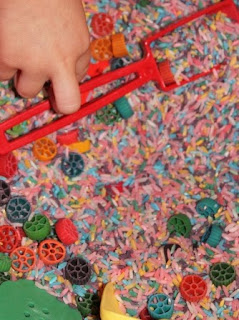
Rice Tray
I choose to use rice instead of sand in the classroom or inside the home, because it is easier to clean up and it is cheap.  I also prefer rice over beans because you can vary the color and it smells better.  You will want to base your tray size from the age of your students.  For a kindergarten classroom, I would probably use something similar to a shoe box.  It is deep and small.  For middle school or older, you could use something much larger and less deep. 
I then put various colored rocks, stones, and other objects in a bag next to the tray.  I also have a rake, shovel, cup, etc.  These allow for the child to explore in the rice tray, gaining the full sensory experience.
The location of the tray should be somewhere off from the rest of the class and in a quiet place.  I found that most teachers like to keep it close to their desk so they can be near the student that is using it.  What you don't want is a student that is disregulated trying to soothe and calm themselves down in the rice tray, and then being surrounded by a bunch of other loud students.
Here is a link on how to color rice: How to Color Rice


Scented Play Dough
This works great to help a hyper or energetic student to refocus.  I had the teachers take small Ziploc bags with a small amount of scented play dough and keep them in their desk.  Whenever they would notice a student getting off task or fidgety, they would hand them the play dough to use for 10 minutes.  For older students, the teacher just left some out on her desk and the students would use it as needed.
Here is a link to make your own: Scented Play Dough

Weighted Animals
These are simple to make.  I just open up a stuffed animal (I try to find something shiny and unisex so the boys like it too) and add some beans, colored floral stones, or whatever I have around.  I then stitch it back up.  It's not always a pretty stitch, but that is usually part of the appeal to the kids.  I have the teachers let a "special helper" get to carry the animal or care for the animal.  I tell the teacher that a student who seems like they just need a hug or just need some time on their own is perfect for this "special helper."  The added weight in the animal helps to provide a unique sensory experience that can re-center and regulate their body.  This also worked great for students that had a hard time in line and with transitions during the day.
Here is a link to buy weighted objects: Weighted blankets and animals


Music or Quiet Station
This is in a small corner of the classroom, or for older kids, could just be a portable cd player they can have at their desk.  I include comfortable headphones, not the ones that go inside of the ear, a CD player, and a nature or relaxation cd.  Sometimes the noise of the classroom, cafeteria, gym, or recess can be too much for some students, so having the soothing nature sounds can help them to regroup and get ready to participate in the classroom.

There are many more sensory play activities that you can incorporate into your lesson plans and use if you find that your students are really benefiting from the extra sensory experiences.  However, if you keep these few around your classroom and use them regularly, you should notice a decrease in outbursts and misbehavior.

For parents, if you have a child who seems to be struggling in the classroom, these are great things to suggest to your child's teacher.  You could even make a small sensory kit for your child to take to school and use as needed. 

Monday, August 27, 2012

What is Theraplay


Theraplay is a special type of play therapy.  It works on attachment skills in children and is a registered trademarked specialization that a play therapist can receive.  I do not have a theraplay specialization, however, I have attended various trainings on theraplay and use theraplay games and activities with specific clients often. 

Here is a 5 minute video about Theraplay
Theraplay Video

A little longer, but very informative video about Theraplay
Theraplay Video 2

I have used Theraplay activities during my play therapy sessions to work on:
  • Self-control
  • Decreasing aggression
  • Social skills
  • Foster parenting
  • Adoptive parenting
  • ADHD
  • Sensory Processing Issues
  • Anger Issues
  • Trauma Healing

What I love about Theraplay is that it brings the parents in so what we do in session can easily flow into the home.  This means that the actual counseling sessions can be fewer and further progress is made at home.  I have seen so many children benefit from theraplay games that otherwise struggled in typical play therapy. 

For more information regarding Theraplay, check out the Theraplay Institutes's website http://www.theraplay.org/


Thursday, August 23, 2012

20 Ways to Engage Your Child About Their Day

Perfect for toddlers, children, tweens, teens, and families of all


As a parent or guardian, you know that it is vital to stay in the loop about your child or teen's day.  However, we often get the "I don't know" or "it was fine" response when we ask then how their day was...or at least I do :)

Here are some things that I have found are helpful and usually get me a better response.  Most of the time these lead to conversations about their day and help us as a family to stay actively involved in each other's days.

  1. Ask them to give a high and low point from their day.  You could even add a high five when they say their high and a low five when they say their low.  That would be fun for active kiddos.
  2. Use chalkboard place mats (you could DIY) at dinner time to draw a picture of their day and then parents have to guess what the event is.  A link for how to make one
  3. Place a feeling magnet board on fridge or in car for them to pick a feeling from their day and share about it. Here is a link to buy a mood magnet or you could make your own.
  4. Create a feeling face poster and put it somewhere in the house.  Each child has a certain color post-it note and can put post-its on their feelings from that day.
  5. Have your child that has a cell phone take a picture of something from their day and you do the same, then at the end of the day you can swap pictures.
  6. Use a decorative "talking stick" (I like to use a glitter baton) in the car and pass it around to share stories from their day.
  7. Each child gets an Oreo cookie, and as you are eating it you have to share a positive (top layer), a negative (middle layer), and another positive (bottom layer) from their day.
  8. During bedtime tuck in ask them something they are thankful for from that day and something they wish for tomorrow.
  9. Ask for the first thing that pops into their mind about their day when you say a key word (i.e. recess, lunch, teacher, friend, classroom, etc.).
  10. Play two truths and a lie from their day and you have to guess which is the lie.
  11. Use play dough to make a picture or symbol from their day.
  12. Trace their hand and fill in five fingers with five events from the day.
  13. Have the child make a sound and you have to guess what part of the day it is from.
  14. Have the child make a face and you have to guess what caused that face during the day.
  15. Play balloon pass, whoever lets it touch the ground has to share a story from their day.
  16. At bedtime, or even right when they get home, use "magic lotion" (just special lotion that is only used for this.  mine has sparkles) and ask if they have any hurts, inside or outside, that need to be taken care of.
  17. Draw a picture on each others backs of a feeling face from some time during they day and share what caused that face.
  18. Share a gold fish snack using the colored gold fish.  Label the colors with things from the day (red = recess, purple = peers, green = good things, yellow = yucky/bad things, orange = okay things)...could use small skittle or m&m packs if you want.
  19. Cut up strips of different types and colors of scrap book paper.  Have child pick a few out that represent different things from their day.  For example, black paper might be something bad that happened, while sparkly pink paper is a memory of something good.
  20. Play charades and take turns acting out things that happened during the day.

I always think it works better if the parent plays the game too.  This models for the child or teen how to share and that it is fun in the family to swap stories.  It also gives them insight into your day and what you do while they are not with you.

What are some other things you like to do to engage your child?

Wednesday, August 22, 2012

Snack in a Play Therapy Session

Snack Time


(I will preface this post with snack is not appropriate for all clients, nor is any client the same as the any other.  You have to use your discretion as a play therapist to see what would be best for them.) 

I love to end my sessions with "snack and story time" or "snack and share time."  Snack time provides a time where my client and I can have a few minutes at the end of the session to recap, set goals, build our attachment and trust to one another, and continue in our therapeutic relationship.

During the intake with the parents, I ask about any allergies and get their permission to have snack time with their child.  I then leave about 10 minutes at the end of every session for snack.  Sometimes, (mainly with the younger ones) we read a book and can process it while they eat.  Since they are eating, they are usually a fairly captive and engaged audience.  Sometimes, we play a game and have sharing time.  For example, I often use the colored gold fish as my snack.  During my first meeting with a client I might have them separate the goldfish into piles based on their colors and then assign something to each color for them to share.  I might have the red be "something that makes you mad," and the green be "something that scares you."  This provides a non-threatening, easy way for us to get to know one another.  I even play sometimes too :) 

When I was working as a school based therapist, I found that snack provide a wonderful closing to the session for a child before returning to class.  If a child had gotten really wound up and energetic during a session, they could relax and calm before returning to class.  Also, if they had experienced other strong emotions during their session, they could regain their composure before facing their peers again.

The greatness that comes from snack time:
  • Builds attachment skills within the child through nurture (part of the theraplay model)
  • Creates a routine and ritual that a child can rely on and find security in
  • Gives the child a chance to process their session
  • Can include family members to have structured sharing time before ending the session
  • Can provide time to read a book to a child and family
  • Gives the child a chance to soothe and calm before returning to the real world
  • Gives me as the therapist an opportunity to gather information if needed by structuring a game to play with the snack
  • If working with on building attachment, you can include the parent in snack time and build that bond
  • Great for group therapy with children, because it can provide a structured sharing time or story time
  • It is fun for the child!
  • Even teenagers and adults love it and look forward to it.  Many are curious what game we will play during snack time each week.

What are your thoughts on snack time? Therapists, do you use snack time in your sessions?  Teachers, do you find benefits in snack time?  Parents, how do you feel about snack during a counseling session?


Location:

108 E Central Ave.
(On the square, above Table Mesa)
Bentonville, AR 72712

About Me

Licensed Associate Counselor, Licensed Assoicate Marriage and Family Therapist, Registered Play Therapist