Showing posts with label classroom. Show all posts

Tuesday, September 4, 2012

Sensory Play

I talk about sensory play a lot!  It is one of the things that I use in my practice as well as my daily life with my own child.  I am a firm believer that keeping our senses regulated helps us to control our behaviors and better understand the environment around us. 

However, sensory play and regulation is crucial in the classroom as well.  I have seen students that were struggling with acting out find ways to calm themselves down and be a successful student again after engaging in sensory play.  After working with many teachers on ideas for sensory experiences in their classroom, I thought that these things could also be set up at home.  I have begun working with parents to set up sensory stations at home and educating them on the benefits of how to use them so their family is calmer and their child is more regulated.

Here are some of the most successful sensory stations that I have used:
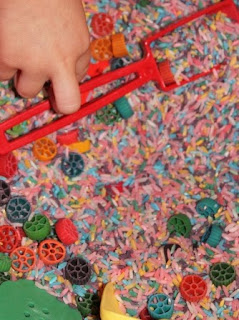

Rice Tray
I choose to use rice instead of sand in the classroom or inside the home, because it is easier to clean up and it is cheap.  I also prefer rice over beans because you can vary the color and it smells better.  You will want to base your tray size from the age of your students.  For a kindergarten classroom, I would probably use something similar to a shoe box.  It is deep and small.  For middle school or older, you could use something much larger and less deep. 
I then put various colored rocks, stones, and other objects in a bag next to the tray.  I also have a rake, shovel, cup, etc.  These allow for the child to explore in the rice tray, gaining the full sensory experience.
The location of the tray should be somewhere off from the rest of the class and in a quiet place.  I found that most teachers like to keep it close to their desk so they can be near the student that is using it.  What you don't want is a student that is disregulated trying to soothe and calm themselves down in the rice tray, and then being surrounded by a bunch of other loud students.
Here is a link on how to color rice: How to Color Rice


Scented Play Dough
This works great to help a hyper or energetic student to refocus.  I had the teachers take small Ziploc bags with a small amount of scented play dough and keep them in their desk.  Whenever they would notice a student getting off task or fidgety, they would hand them the play dough to use for 10 minutes.  For older students, the teacher just left some out on her desk and the students would use it as needed.
Here is a link to make your own: Scented Play Dough

Weighted Animals
These are simple to make.  I just open up a stuffed animal (I try to find something shiny and unisex so the boys like it too) and add some beans, colored floral stones, or whatever I have around.  I then stitch it back up.  It's not always a pretty stitch, but that is usually part of the appeal to the kids.  I have the teachers let a "special helper" get to carry the animal or care for the animal.  I tell the teacher that a student who seems like they just need a hug or just need some time on their own is perfect for this "special helper."  The added weight in the animal helps to provide a unique sensory experience that can re-center and regulate their body.  This also worked great for students that had a hard time in line and with transitions during the day.
Here is a link to buy weighted objects: Weighted blankets and animals


Music or Quiet Station
This is in a small corner of the classroom, or for older kids, could just be a portable cd player they can have at their desk.  I include comfortable headphones, not the ones that go inside of the ear, a CD player, and a nature or relaxation cd.  Sometimes the noise of the classroom, cafeteria, gym, or recess can be too much for some students, so having the soothing nature sounds can help them to regroup and get ready to participate in the classroom.

There are many more sensory play activities that you can incorporate into your lesson plans and use if you find that your students are really benefiting from the extra sensory experiences.  However, if you keep these few around your classroom and use them regularly, you should notice a decrease in outbursts and misbehavior.

For parents, if you have a child who seems to be struggling in the classroom, these are great things to suggest to your child's teacher.  You could even make a small sensory kit for your child to take to school and use as needed. 

Tuesday, August 21, 2012

Water Beads

picture from theimaginationtree.com
At the teacher fair I attended recently, I had a bowl of water beads set up on my booth.  The response from the teachers were so positive and many asked where they could purchase them and what they are used for.  Well, here you go...

I use water beads in play therapy as a sensory experience.  When the senses are regulated then the brain can learn and absorb new things.  Water beads are fun for both boys and girls and are not going to be messy.  They are perfect for those kiddos who don't like to have residue on their hands. 

This website is about where to get water beads and different ideas that she does in her classroom with them.
http://www.teachpreschool.org/2012/05/the-wonderful-world-of-water-beads/


If I was a teacher with a classroom, I would try to keep some sort of soothing sensory tool behind or in my desk to hand to a student that was struggling with self-control.  A bowl or bag of water beads would be great for this.  Give the student a 5-10 minute timer to sit by your desk and enjoy their sensory experience.  Trust me, you will be amazed how much less energy you have to put in to discipline when you catch them before they start acting out.

What other ideas do you have for water beads?

Some other websites about water beads:
Water bead sensory tub
The wonder of water beads
32 ways to play with water beads

Monday, August 13, 2012

Anger Box


I recently did a raffle for an 'Anger Box' at a teacher fair that I attended.  The teachers seemed excited and interested in having one in their classrooms.  Unfortunately, only one teacher could win, so I thought I would share how you could make your own.  They can be as simple or as elaborate as you want, and you can always change it up throughout the school year.

Side note, you can call this box of tools whatever you like.  I have seen it called a 'Calm Down Box,' a 'Helper Box,' and a 'Meditation Box.'  You can pick whatever works best for you.

First, I like to use large plastic tub with a lid.  This is durable and will hold up to a lot of use.
Items that you could put in your box:
- Stress balls or some type of squeeze balls
- Play dough (they make scented play dough, which would be great but is a little more $)
- Bubbles (again, they make scented ones)
- Paper for drawing and/or journaling
- Markers and crayons
- Stuffed animal for cuddling, hugging, or talking to
- Eye mask
- Bubble Wrap (this can be loud so might be best for the hallway, but it can work wonders)
- A "mind jar" Here is a link on how to make one (I like to use a plastic water bottle rather than glass)
- A book or two
- A CD of soothing nature sounds, a cd player, and headphones
- Lavender scented lotion
- Peppermints
- A small puzzle

There are a few ways that I think work well for teachers to use their box.
1) You can instruct the student to go to the anger box, shake up the mind jar (so this can be the timer for you), and then use the box to calm down
2) You can have the student grab one thing from the anger box and then return to their desk or area to use what they chose
3) You can combine these two options by instructing the child to use the mind jar as their timer and only pick one or two items from the box to use until the glitter settles in the mind jar

I use option three the most. I find that children who are angry or upset can get overwhelmed with all of the choices in the box. 

I also like to go and talk with the student after the "timer" (mind jar) has finished.  This way I can make sure they are ready to rejoin the class.

Again, you can put lots of different things in your box.  The idea is to work the child's senses and help them to return to a point of self-regulation.  Touching soft things, squeezing things, taking deep breaths with the bubbles, smelling calming things, hearing calming things, moving in a soothing manner (like coloring), tasting calming things, can all help a child return to a state of self-control.

What are some items that you like to put in your anger box?

Location:

108 E Central Ave.
(On the square, above Table Mesa)
Bentonville, AR 72712

About Me

Licensed Associate Counselor, Licensed Assoicate Marriage and Family Therapist, Registered Play Therapist